

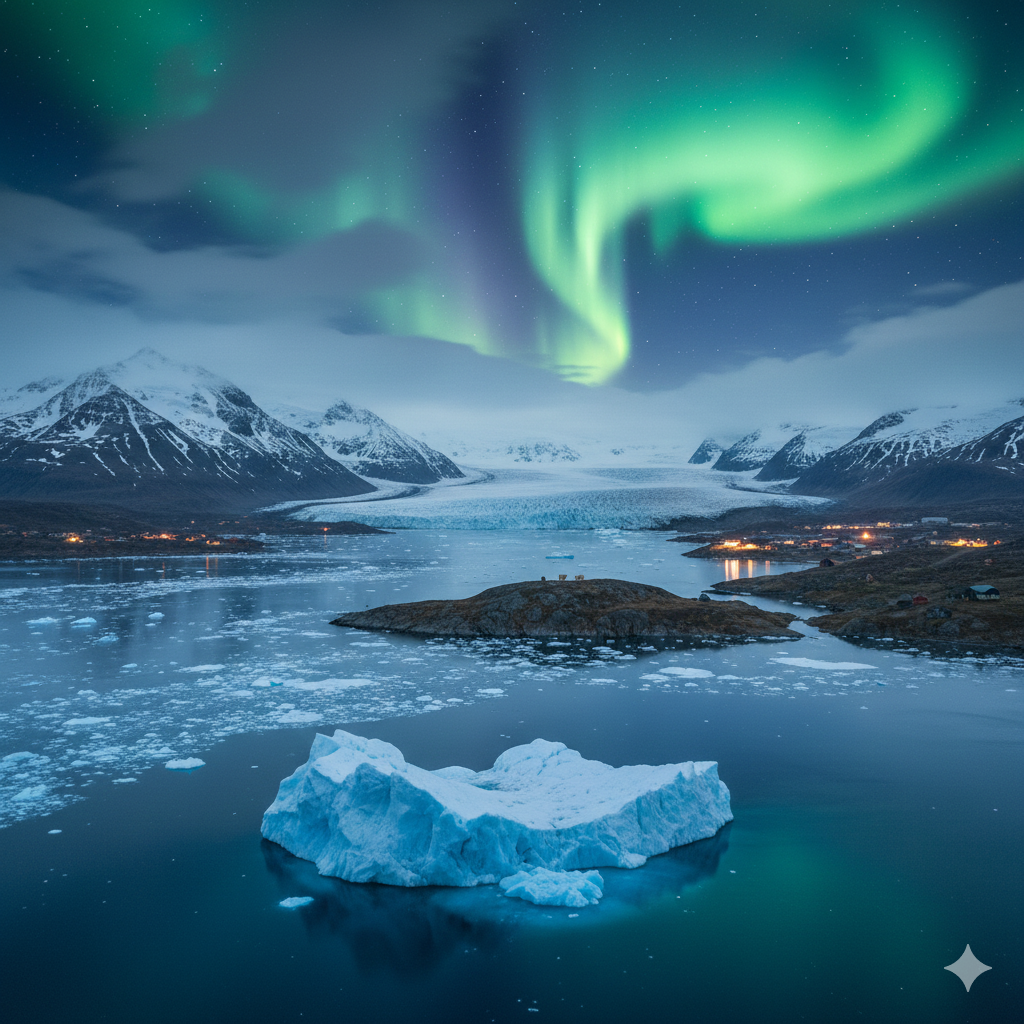
Vancouver: As the Arctic re-enters great-power politics, Greenland has become a test not just of strategy, but of restraint. How the United States (US) and Europe handle it will shape the credibility of the transatlantic alliance.
Geography has a way of reasserting itself when politics grows careless. Greenland, long treated as a frozen periphery, has returned to the centre of strategic debate not because it has changed, but because the world around it has. Once the concern of military planners alone, the island is now a diplomatic fault line — exposing tensions between power, alliance management, and international norms.
That reality was underlined last week when France, Germany, Italy, Poland, Spain and the United Kingdom issued a joint statement backing Denmark and Greenland amid renewed pressure from Washington. Such collective clarity is rare in European diplomacy. It reflected a shared concern that Greenland is no longer just an Arctic issue, but a measure of how far strategic necessity can be pursued without eroding the principles that underpin Western security.
Greenland’s importance rests on an old and stubborn fact: maps still matter. Positioned between North America and Europe, it anchors the northern Atlantic space linking the two continents. The Greenland-Iceland-UK (GIUK) gap has shaped defence planning since the Second World War, when Allied forces recognised its importance for controlling air and maritime access to Europe.
During the Cold War, this corridor was vital for tracking Soviet submarines and bombers. Today, the threats are different but the logic remains. The Arctic is still the shortest route for intercontinental ballistic missiles between Russia and North America. It is also increasingly relevant for space surveillance, satellite tracking, and the protection of undersea cables.
This is why the U.S. military presence at Pituffik Space Base — formerly Thule Air Base — remains central to American defence planning. Its radar and tracking systems feed directly into missile early-warning and space-domain awareness networks. In an era of hypersonic weapons and shrinking decision windows, early detection from the High North is not a relic of the Cold War; it is a core requirement.
Europe’s stake is no less direct. The security of Atlantic sea lanes, digital infrastructure, and NATO reinforcement routes all depend on stability in the northern maritime space. Any serious disruption in the GIUK gap would have immediate consequences for European security.
Greenland’s renewed prominence reflects wider shifts in the Arctic itself. The region is no longer insulated from global competition. Russia has already invested huge in upgrading its Arctic military posture as it has reopened its airfields and expanded its radar coverage, and also reinforced its Northern Fleet. It has enhanced the Moscow’s power into the North Atlantic.
China has declared itself a “near-Arctic state” and expanded its presence through research, commercial projects, and diplomacy. Its has interests in shipping routes, data infrastructure, and long-term access to resources . It’s all are part of a broader effort to reduce strategic points, dominated by others.
For the US, maintaining influence there limits the strategic space available to rivals. President Donald Trump has expressed this sharply and argued that without U.S. control, Greenland could fall under Russian or Chinese influence — despite the fact that Washington already operates critical military infrastructure on the island.
Trump’s rhetoric on Greenland fits a broader pattern of assertive U.S. behaviour that often sidelines legal and diplomatic restraint. In recent weeks, Washington has struck Venezuela, abducted President Nicolás Maduro, and issued threats against Iran, Colombia and Mexico. Against this backdrop, talk of “control” over Greenland resonates far beyond the Arctic.
For Europe, the issue cuts deep. Denmark is a NATO ally. Greenland is a self-governing territory with a clear political voice. Suggesting that its future can be dictated by force or pressure challenges the very principles of sovereignty and consent that Western alliances claim to uphold.
This explains the unusually direct European response. The statement by six major European powers was not anti-American, but pro-process. It reaffirmed that security in the Arctic must rest on consultation, legality, and respect for territorial integrity. Greenland’s own leaders have been equally clear: the island is not for sale, and its people alone will decide its future.
The episode exposes a quiet tension within NATO — between the possession of power and the legitimacy of its use.
Despite the drama, U.S. interest in Greenland is not new. It dates back more than 150 years. In 1867, the same year Washington purchased Alaska from Russia, Secretary of State William Seward ordered a detailed survey of Greenland. Fresh from expanding America’s northern frontier, he understood the long-term value of Arctic geography.
That logic persisted. During the Second World War, the United States assumed responsibility for Greenland’s defence with Danish consent. During the Cold War, it embedded military infrastructure that remains operational today. What has changed is not American interest, but the global environment in which it is pursued — one where alliances, law, and public legitimacy matter more than ever.
Greenland’s strategic value extends beyond defence. The island is believed to hold significant deposits of rare earth elements and other critical minerals essential for clean energy technologies, advanced electronics, and modern weapons systems. As the U.S. and Europe seek to reduce dependence on Chinese supply chains, Greenland naturally enters strategic calculations.
Warming temperatures are sharpening this interest. Retreating ice is making Arctic waters more navigable and lengthening the window for commercial and military activity. At the same time, it is heightening environmental risks and political sensitivities. Many Greenlanders remain sceptical of large-scale mining and extraction, concerned about irreversible ecological damage and the impact on local communities. Strategies that view Greenland primarily as a storehouse of resources, rather than a lived and governed society, are more likely to generate resistance than stability.
Greenland is not a vanity project or a colonial leftover. It is a strategic anchor, a surveillance platform, a logistical hub and a denial asset combined. Losing influence there would not cause immediate collapse, but it would signal retreat — the kind rivals notice long before electorates do.
What Greenland requires now is seriousness, not spectacle. That means sustained diplomacy, fair arrangements with Denmark, respect for Greenlandic self-rule, and recognition that security in the Arctic cannot be built through coercion without cost.
Trump’s focus on Greenland reflects a hard strategic truth: the map leaves little room for alternatives. But power exercised without restraint has a habit of undermining the very security it seeks to protect. In the High North, as elsewhere, the strength of the West will be judged not only by where it can reach, but by how wisely it chooses to do so.