




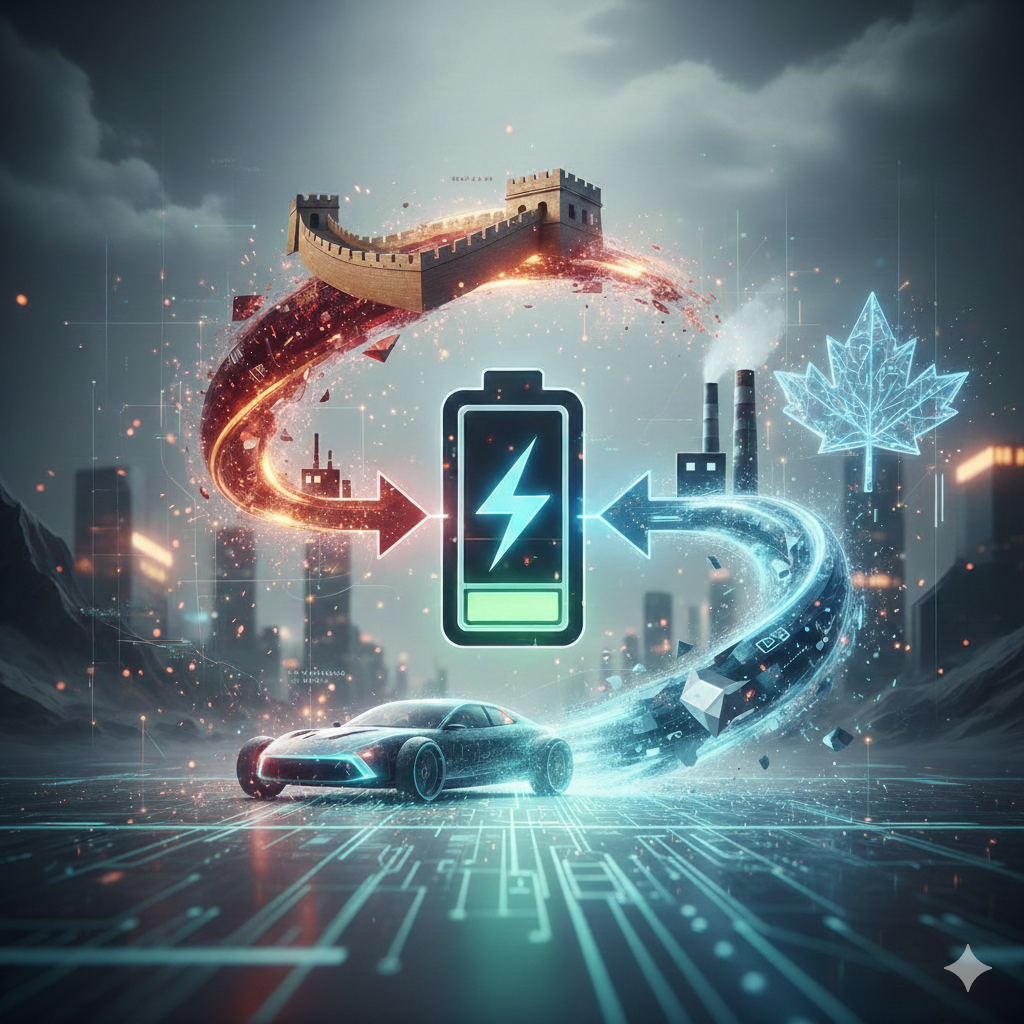




When nations take trade decisions, they rarely do so in a vacuum. They respond to pressures – domestic politics, geopolitical anxiety and economic fatigue while the quiet fear of being left behind, also contributes largely. Canada’s recent decision to strike an electric-vehicle (EV) trade arrangement with China must be read through this lens: not as a sudden embrace of Beijing, but as a reluctant recalibration in a world that has become far less forgiving to middle powers.
At a time when global trade is fragmenting into blocs and alliances are strained by protectionism, Ottawa has chosen pragmatism over orthodoxy. By agreeing to sharply reduce tariffs on Chinese EVs in exchange for relief on Canadian agricultural exports — especially canola — Canada has signalled that economic survival sometimes demands uncomfortable choices. But Canada’s recent decision to strike an electric-vehicle (EV) trade arrangement with China, has consequences that stretch far beyond trade balances as it will also impact provincial politics, relations with Washington, and the future of Canada’s industrial identity.
Canada’s agriculture sector has long been collateral damage in diplomatic standoffs with China. Canola farmers have endured years of restricted access to one of their largest markets. The reopening of that door was not merely symbolic; it was existential. For Ottawa, continuing to absorb agricultural losses in the name of geopolitical alignment was becoming politically unsustainable.
The EV concession, therefore, is not ideological. It is transactional. Canada lowered its guard on Chinese EV — within limits and quotas — to secure immediate economic relief for a sector that had run out of patience. In doing so, it acknowledged a reality that policymakers often avoid admitting: moral posturing is easier when it does not come at a direct economic cost.
At the federal level, the deal has been framed as balance — diversification without capitulation. Officials argue that Canada cannot afford to tie its economic future entirely to the United States, particularly as American trade policy grows more inward-looking and unpredictable. In this reading, engaging China selectively is not betrayal but insurance.
No province has reacted more sharply than Ontario, where the automotive industry remains both an economic pillar and a political touchstone. Unionized labor forms a tightly woven ecosystem that depends heavily on access to the U.S. market and protection from unfair competition.
Ontario’s leadership fears that even a controlled inflow of low-cost Chinese EVs could destabilise this ecosystem. The concern is not volume alone, but precedent. Once the door is opened — even slightly — it becomes harder to argue for its closure later. Provincial leaders worry that domestic manufacturers, already under pressure from rising costs and technological transition, may find themselves competing with state-subsidised giants operating on an entirely different scale.
Behind the rhetoric lies a deeper anxiety that Canada’s long-promised EV manufacturing renaissance may never materialise if the market is flooded too early with cheaper imports. For provinces that have invested political capital and public money in courting battery plants and auto investments, the deal feels like a gamble taken without their consent.
No analysis of Canadian trade policy is complete without considering the United States. Supply chains cross borders seamlessly, particularly in the automotive sector, where vehicles and components may cross the frontier multiple times before completion.
Washington’s discomfort with Canada’s EV deal is therefore unsurprising. The United States has taken a hard line against Chinese electric vehicles, viewing them not only as economic competitors but as strategic instruments of state policy. From Washington’s perspective, a softer Canadian stance risks creating loopholes — real or perceived — in North America’s defensive trade wall.
Yet America’s response has been cautious rather than confrontational. This restraint reflects reality. The U.S. needs Canada — for energy security, continental defence, and climate cooperation. Overreaction would risk destabilising one of its most dependable alliances.
Even so, the decision leaves a subtle but unmistakable tension in the air. Ottawa is reminded that stepping out from Washington’s shadow, even carefully, carries real consequences. Every move toward trade diversification has a diplomatic cost, and even small departures from U.S. expectations draw scrutiny. Canada now finds itself on a narrow ledge, trying to reassure its closest ally while holding on to the freedom to act in its own economic interest.
Beyond the boardrooms and policy briefings, the effects are felt most sharply everyday by Canadians. Through the lens of climate policy, the stakes are high. More affordable EV could accelerate emissions reductions and make clean transportation attainable not just for wealthy urban residents, but for families and communities across Canada. In this narrow sense, the deal aligns with Canada’s environmental ambitions more convincingly than many domestic subsidies ever have.
But this benefit carries its own contradictions. Cheaper imports may weaken domestic innovation, discouraging investment in Canada’s manufacturing sector. It is a paradox at the heart of the agreement: it advances sustainability while potentially compromising the economic foundations that make that progress possible.
Canada’s relationship with China in recent years has been defined more by tension than by reconciliation. Diplomatic stand-offs, retaliatory trade measures, and deep-seated mistrust have left scars that a single agreement cannot erase. The EV deal does not erase this history; nor does it signal trust. It signals fatigue.
Beijing, for its part, sees opportunity. Re-entering the Canadian market, even in a limited capacity, helps normalise Chinese technology and manufacturing at a time when it faces exclusion elsewhere.
Canada’s decision on electric vehicles reveals a broader reality for middle powers in a world dominated by great-power rivalry. Principles do matter, but influence also matters more. Countries , which are without the economic clout of the United States or China should steer carefully.
The deal is neither a triumph nor a surrender. It is a calculated risk taken in an unforgiving global environment. Whether it pays off will depend on what follows — investment in domestic industry, protection for workers, transparency in implementation, and steady diplomacy with allies.