


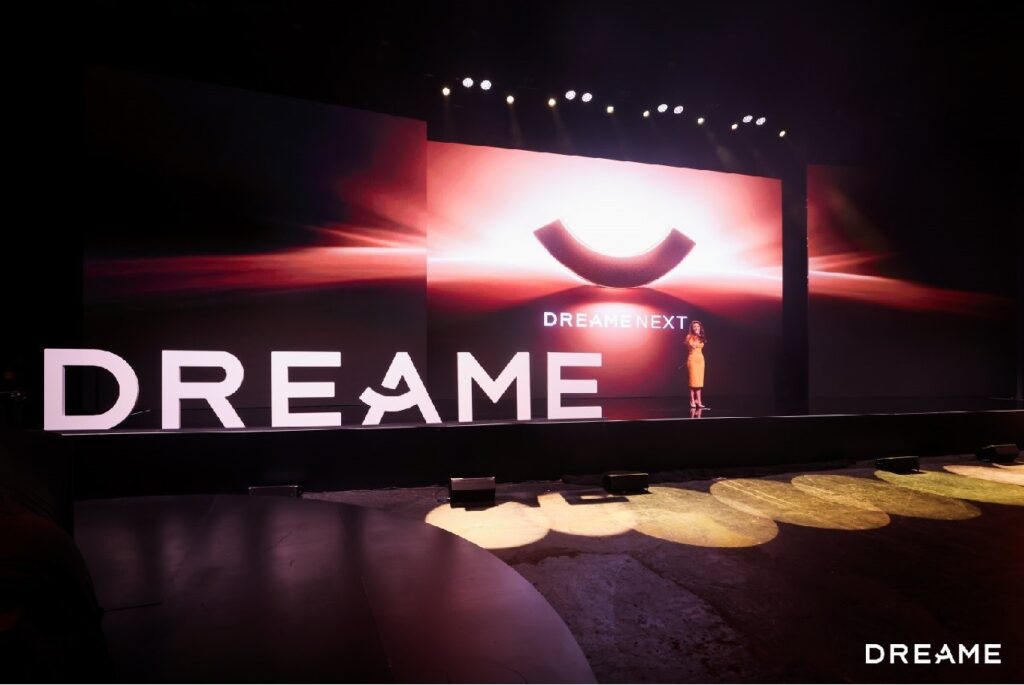
SAN FRANCISCO: Most consumer technology brands that try to enter the American market either translate their products for U.S. shelves and hope for the best, or they pour money into marketing without earning the trust that American consumers actually require.
Dreame Technology is doing something different. Over four days at the Palace of Fine Arts this week, the company unveiled an electric hypercar, three smart rings, a modular smartphone, AI smart glasses, a refrigerator running Google’s Gemini AI, an air conditioner with two robotic arms, a laundry robot that folds clothes, and dozens of other products targeting nearly every category of American consumer life.
What was striking was not the breadth of the lineup, though it was substantial. What was striking was how Dreame is executing the entry through Western credibility partnerships, genuinely localized product thinking, and the kind of patient retail expansion that turns a foreign brand into a household name over time.
This is what Chinese consumer tech expansion looks like when a company is doing it right.
The hypercar opens the door
Dreame opened Monday morning with the Nebula NEXT 01 JET Edition — an electric hypercar with quad motors and solid rocket boosters, targeting 2027 production at a planned German factory. The car is Dreame’s most ambitious leap beyond consumer appliances and signals serious intent to compete in premium automotive categories.
Sebastian Thrun, who founded Google’s self-driving car project and now runs an electric flying-car company, joined the launch program toward the end of the morning. He spoke about the broader future of mobility, telling the audience that humanity has built only about 1 percent of what it could invent. He discussed batteries, autonomous systems, and flying cars.
That a Chinese consumer brand brought one of the most credible voices in autonomous driving to its San Francisco stage represents a meaningful shift. Until recently, the kind of Western credibility that Thrun’s appearance carried was reserved for established American and European firms. Dreame is one of the first Chinese consumer companies to systematically build these kinds of Western validation relationships at scale.
Smart rings that move into a new category
Dreame announced three smart rings at the event — an AI Vibration Smart Ring, an AI Health Smart Ring with electrocardiogram functionality, and an AI Smart Ring with near-field communication. The company said the rings will be sold without monthly subscriptions, distinguishing them from Oura, the Finnish company that has dominated the smart ring category over the past decade.
The strategic insight is in what Dreame’s smart ring team revealed in an interview. They said the company is considering moving toward more luxurious and stylish ring designs over time — positioning that would compete with traditional jewelry brands rather than fitness trackers.
That is genuinely new territory. Most current smart ring competitors compete on biometric features — algorithm depth, sensor sensitivity, app integrations. None have meaningfully positioned smart rings as jewelry. Dreame has signaled it might. For affluent American consumers who already wear rings as status objects, the prospect of smart rings designed for that aesthetic is a real differentiator that no Western tech brand has staked out.
The Robot Vacuum’s success has already been earned
iRobot, the American company that invented the robot vacuum in 2002, filed for bankruptcy in 2024. The top five robot vacuum brands globally are now all Chinese. Dreame is positioned in the top three.
Dreame’s North American performance demonstrates that the strategy is working. Robot vacuum sales grew 150 percent year-over-year in the first quarter of 2026, with U.S. market share approaching 10 percent. Wet and dry vacuum sales grew 235 percent, with the U.S. share approaching 20 percent. The company opened its first U.S. retail store in October 2024 and expanded to multiple flagships throughout 2025, including a location in Silicon Valley. By the fourth quarter of 2025, offline channels accounted for over 20 percent of total sales.
The general manager of Dreame’s North America business, in an interview, shared what may be the most telling moment of the week. Asked which product he was most excited about, he named one that does not yet exist — a robot vacuum that could climb stairs.
His reasoning was specific. American homes, particularly multi-story townhouses common in U.S. suburbs, require products engineered for that market. A vacuum that handles only one floor is a fundamentally limited product for an American household. A stair-climbing vacuum would solve a problem unique to the American market.
This is the kind of localized engineering thinking most Chinese consumer brands have failed to execute. Most translate Chinese products for Western shelves; Dreame is engineering for American homes specifically. That difference is what distinguishes a brand that succeeds in the U.S. from one that doesn’t.
The smartphone enters a tough market with a fresh approach
Dreame’s modular AURORA NEX smartphone has a detachable triple-camera that has its own processor and shoots remotely over Wi-Fi. Steve Wozniak, who co-founded Apple, joined a panel at the launch event with Counterpoint Research analyst Jeff Fieldhack and Dreame’s Global President.
The U.S. smartphone market is dominated by Apple and Samsung, and Chinese smartphone brands have historically struggled to gain U.S. traction. Dreame is taking a fundamentally different approach. Rather than trying to out-iPhone the iPhone, the modular design — detachable cameras, satellite modules, AI processors that can be swapped — represents a real reimagining of what a flagship smartphone can be.
Whether American consumers respond to that approach is the open question. But the strategy is genuinely different from what Apple and Samsung currently offer.
The smart home appliance lineup is the under-told story
The Living Next portion of the event introduced more than 20 smart home appliances. The Z1 Laundry Robot, which won a “Best of CES 2026” award, sorts, washes, dries, and folds clothes independently. The X60 air conditioner has two robotic arms creating different airflow zones for different people in the same room. The N1 refrigerator runs Google’s Gemini AI for ingredient recognition and recipe suggestions.
The Dreame-Google partnership embedded in the N1 refrigerator is one of the most interesting business stories of the week. While public conversation has emphasized U.S.-China tech tensions, a Chinese consumer hardware brand and Google Cloud have struck a substantive AI partnership for consumer products launching this year. This kind of cooperation across the U.S.-China divide deserves more attention than it is currently getting.
For consumers shopping for premium smart home appliances, Dreame represents a credible new option in a category that has been dominated for decades by Samsung, LG, and Whirlpool. The breadth of Dreame’s appliance lineup, combined with the engineering coherence of using the same robotic arm and motor platforms across categories, makes this one of the more substantive entries into the U.S. premium appliance market in years.
What’s worth watching
Dreame’s path forward includes real challenges. The hypercar’s 2027 production timeline depends on a German factory that is still in development. The smartphone enters a market dominated by entrenched incumbents. The smart rings face an active patent landscape that has produced multiple lawsuits in recent years. The current administration’s tariff environment has been unpredictable across geographies.
These are real questions, but they exist in the context of a company that is executing the U.S. expansion playbook better than most Chinese consumer brands have managed. The Western credibility partners — Sebastian Thrun, Steve Wozniak, NBA endorsements, the Google Cloud partnership — combined with documented North American growth and the kind of localized thinking the GM revealed in our interview, suggest a company that is earning its place in the U.S. market rather than buying it.
For American consumers, the practical implication is that the products entering U.S. homes increasingly come from companies most shoppers have not yet heard of. Dreame is one of the more credible examples of how that transition is happening.
For Western tech brands, the takeaway may be different. The companies that succeed against Dreame will not be the ones that compete on price or specifications. They will be the ones that match Dreame’s investment in localized engineering, credible Western relationships, and patient retail expansion.
Dreame’s week in San Francisco was a declaration of ambition. More importantly, it was a demonstration that a Chinese consumer brand can earn American trust the right way.


